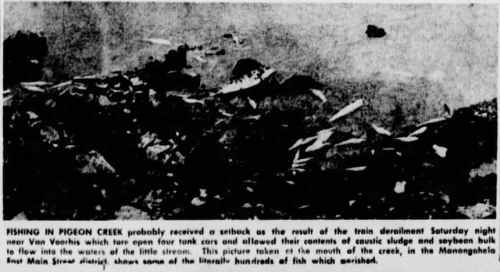
If you’re 70 years old or older and lived in the Monongahela area in 1963, I bet you remember this major train derailment on Pigeon Creek. According to the article, a tank car ruptured and spilled soybean sludge into the creek, killing fish all the way down to the Monongahela River. The sludge was believed to contain Hexane.
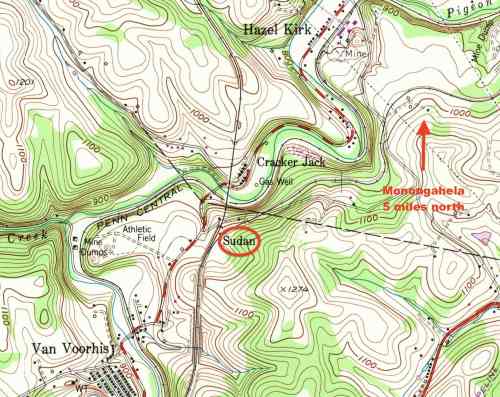
The derailment occurred near Sudan Station between Monongahela and Bentleyville, just south of the intersection of Crackerjack Road and Bentleyville Road. Do you remember the derailment? If you’re too young, why not ask an elder if they recall the event? Maybe even share this post on Facebook. We would love to hear from you, so please share your memories in the comments below!
Newspaper article from The Daily Herald, October 7, 1963:
Fumes Rout 100 Area Families
Train Wreck On P. & W. Va. Spills Sludge
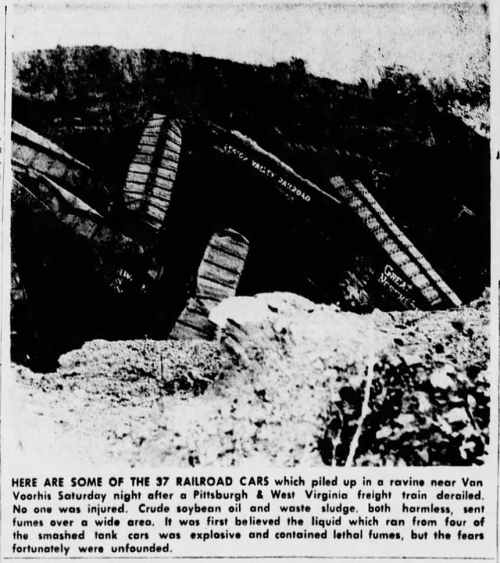
Nauseating fumes-at first believed flammable but later identified as soybean sludge-cleared away over the weekend after being spread over a wide area Saturday night in the wake of a derailment on the Pittsburgh and West Virginia Railroad near the Sudan station, south of Monongahela.
The cause of the accident is still undetermined today, railroad officials said. There were no injuries but first reports received stated that four of the derailed cars of the 103-car train carried flammable and explosive chemicals. However, railroad spokesman said yesterday that fumes given off by the cars containing caustic sludge and soybean bulk had led to this report and prevented authorities from inspecting the cars.
As the cars piled up, the four tank cars ripped open, and the sludge and soybean bulk poured from their tanks, running along the tracks until finding a small crevice which carried the chemicals downward into Pigeon Creek, about 350 yards below the wreckage.
Both soybean and waste sludge, which contains sulfide, gave off highly nauseous odors. A spokesman said alarm was caused by the fact that the soybean oil was thought to be hexane. an inflammable liquid whose fumes are sickening.
Hexane is used in the extraction of soybean oil and the word “hexane” was mentioned on the waybill causing the misunderstanding railroad officials stated. The waste sludge has an acid base neutralized with oil and is used in oil processing.
The train originated in Chicago and derailed in an interchange yard used by the Donora Southern railroad. Approximately 100 families along Pigeon Creek section of Monongahela, Frye Station, Hazel Kirk, Crackerjack and Van Voorhis. were forced to evacuate their homes until an all clear came from a bureau of mines chemical inspector at approximately 11:30 p.m.
Firemen and police from Carroll Township and Monongahela, aided by Civil Defense workers and auxiliary police turned out all pilot lights and open fires in the affected area. They also handied traffic, permitting no one in the area, even on the most rural 1 roads.
Monongabela Fire Chief Sturgis Jackson said the odor from the fumes was nauseating and were so dense in the deep cut where the train derailed that no one was permitted to advance to the wreck scene for a period of time.
He said today that fire trucks at the scene used public address systems to warn residents in the afflicted area. TV and commercial radio stations also helped in the evacuation, he added.
There were approximately 150 men either in the area or on standby at the Monongahela City building until the all clear was given. Monongahela Fire Company after receiving an assistance call from Carroll Township in turn called New Eagle and Sunnyside-Gallatin Fire Companies.
Jackson said the Gil Hall Fire Company was also present with an ambulance and trucks. They were alerted by bureau of mine officials, it was speculated today.
“The Gill Hall Company has access to numerous gas masks from the Large Westinghouse Atomic Plant.” Jackson stated. “We delivered water for one of the steam engines used in clearing the wreckage at four o’clock this morning.” Jackson explained. “The smell was even worse today than yesterday.” The creek is very low and stagnate, with the chemicals just lying there. All the fish in the creck are reported dead today. The odor that remained in Monongahela Sunday, noticed in many churches was caused by a heavy fog earlier in the morning that held fumes down, officials stated.
Monongahela Civil Defense prepared to place into operation plans for the evacuation, by housing the needy in local churches and the Monongahela Armory. The Memorial Hospital was also alerted and later treated people with oxygen and cleaned out eyes affected by the sludge fumes.
After a report came over TV about the evacuation of Monongahela, although erronious, another enormous plan was readied by local Civil Defense to transport residents to nearby communities for housing.
Due to the unknown danger which faced area residents, community officials had to plan for the worst. Today they are glad the leaking chemicals were not those as reported.
Source:
The Daily Herald, October 7, 1963, Page 1. via Newspapers.com (https://www.newspapers.com/article/the-daily-herald-train-derailment-on-pig/106779668/ : accessed February 23, 2026)
Discover more from Lost Monongahela
Subscribe to get the latest posts sent to your email.
 Lost Monongahela
That smell lasted for a couple of months!
LikeLike
I imagine the smell of rancis soubean sludge and dead fish had to be horrible. Was your family evacuated?
LikeLike
No we were from Ginger Hill but passed through on Cracker Jack to Narrow Gauge road almost weekly to visit my Aunt on 481. I was around 7.
LikeLike